Then and Now with Morris Misel · Season 1, The Years
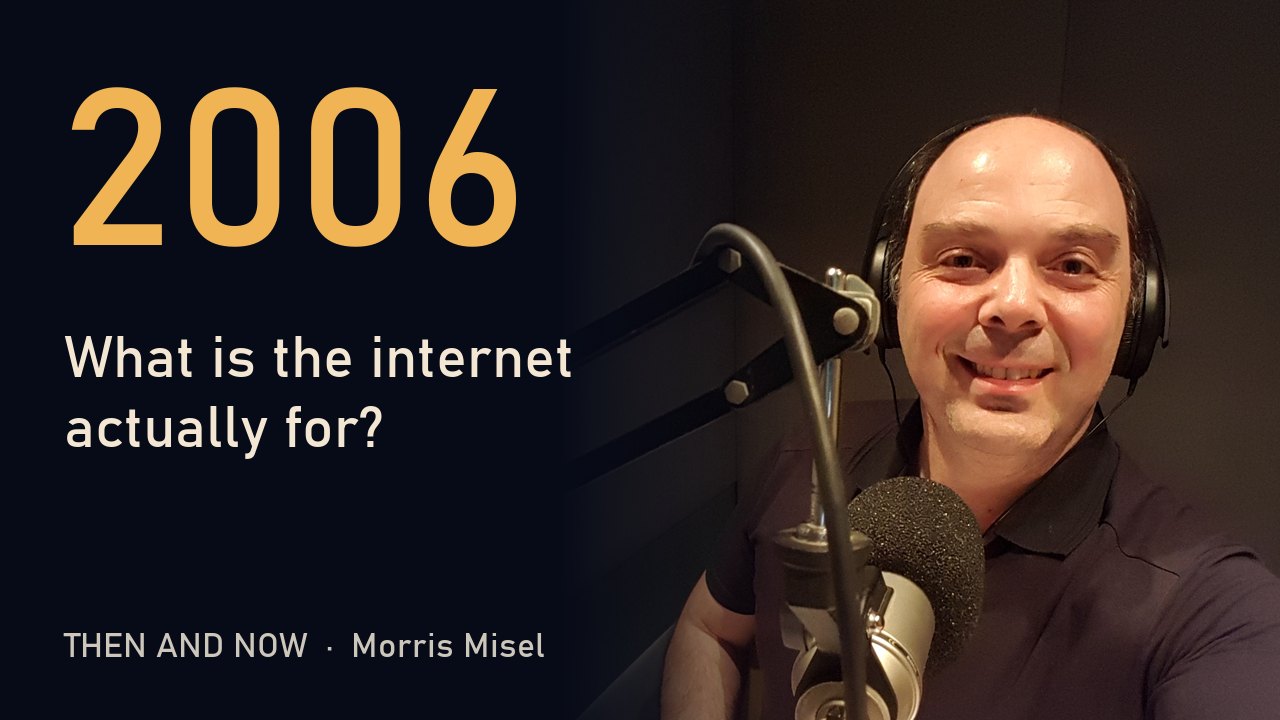
2006: What is the internet actually for?
In 2006 everyone was talking about MySpace, and Facebook had only just opened its doors to the public. I said the internet was turning from a library back into people talking to people. Twenty years on, here's what held, what I had no idea about, and the safety advice that still hasn't changed.
Transcript
Morris, now
This is Then and Now. I'm Morris Misel. For more than 30 years I've been on radio talking about what's coming next.
In every episode I play you something I said with the date on it and nothing changed and then I tell you how it actually turned out and what I make of it now. It's Sunday, the 12th of November 2006 and I'm on 6PR in Perth with Todd Johnston, a regular spot we've been doing for a while. The thing everyone was talking about that week was MySpace.
Facebook had opened its doors to anyone over thirteen at the end of September and almost nobody here had heard of it. Todd asked me whether older people can even find their way online and we end up on a much bigger question which is what's the internet actually for? Have a listen.
On air: 6PR Perth, Sunday 12 November 2006, with Todd Johnston
And there's a sense of community to believe it or not, while we are, you know, I can talk to people in fast-stretching reaches of the world. It is a community-based network, isn't it? It's amazing how much of a community.
You know, the world really is shrinking. The internet started as a form of social networking, strangely enough, in the 1950s. Can you believe it?
Back with ARPA. I mean, let's not worry about what that is, but it was an American set of programs. We wanted to talk to each other about how wonderful they were and what they were doing.
And they figured out a way that using this new technology, this really fan-bangled computer, they could start talking to each other. And then one-on-one they did that and they thought, now, if we can have one-on-three or one-on-five, wouldn't that be great? And that's what they did for about ten years.
They invented those one-to-three, one-to-five, one-to-ten relationships so that you could be on one screen and talk to those ten people. And that really wants the beginning of the internet as we know it. It started as a social networking.
It's blossom now. Now you can create your own MySpace and everything. It's phenomenal.
And it's come such a long way in such a short space of time. When you and I first started going on the internet, we used it more as a library, as a resource. It was somewhere to find a piece of information.
Yeah, true. But now it's really moved on to having, as you said earlier, to having a conversation with people, to finding people across the world, across the town, across anywhere that have similar thoughts or opinions or hobbies or interests. It's a great way of catching up.
And there's also that mask that we have when we're on computers. It's not that face-to-face. We don't feel so intimidated by it.
And you can send photographs of Brad Pitt and say that it's you. Absolutely. You've looked at my website there.
Morris, that leads me to the fact that there is online dating. People are getting very close online. Aren't they?
RSVP, which is Australia's largest online dating, they tell me. And I have nothing to do with them of course, because certainly I don't know the Murdochs who bought it earlier this year for a couple of million dollars. That's how popular it is.
I'm making a killing out of it. Because people just love to get online. They love to be able to put who they are and what they do and have those chats and have those introductory conversations with people and get to know them slowly.
I mean, my sister met her husband online about five years ago, about six years ago, and moved to America. Wow. Yeah.
I haven't seen a sense. Yeah. Morris, that could be a good thing to do.
I think it was more about me then, than the others. Yeah. Well, there's social networking.
There's also business networking, but let's write the issue that security, if you're going to do social networking, business networking on the net, and if you're slightly older than perhaps you or I, security is an issue. It is depending on how you approach it. Look, it really doesn't have to be.
Firstly, never, never, never, never, never, how ever more than ever do you want to after give out your personal information like your address, your phone number, your bank account details, absolutely not. Your passwords, the passwords, what you need to type in to tell them this is who you are. As long as you take basic precautions, set up, most of them will later set up a username, and username is a fancy way of saying a nickname or something that's not yours.
So it might be Morris the Great or whatever you want. I'd start off with something simple like a username that doesn't tell people specifically who you are. Like Barry the Great.
Or Todd the Magnificent.
Looking back
The big one turned out right, and I am still a bit pleased about it. I said the internet started as people talked to people, becoming a library and was turning back into people chatting with other people, and that's pretty much the way the last 20 years in a sentence went. Meta alone counts more than 3.5 billion people a day across its apps now.
I had no idea which names would matter and nobody did. MySpace, the thing everyone was excited about, faded within a few years. And I told people to use a username that wasn't really them for safety and we went and did the opposite.
Real names, faces, kids and lunches, all online. The rest of what I said that day, keep your address, your bank and your passwords to yourself, is still the first thing scam warnings tell you about. When something new turns up now, I ask what it's for, before I ask who will win, and I think MySpace might be why.
Next time, we're in 2007 and everything starts squeezing into one thing into your pocket.
More
That's Then and Now. If you'd like a little of this in your inbox every Tuesday, my email is morrismisel.com/join. And there's more of me to watch, read and talk with at morrismisel.com.